


“They said testing is dead.”
I keep seeing it framed as progress:
Manual testing is dead
Automation replaces testers
AI will do it better anyway
The confidence is impressive.
The understanding is shallow.
What’s actually dying isn’t testing.
It’s a convenient fiction about what testing was supposed to be.
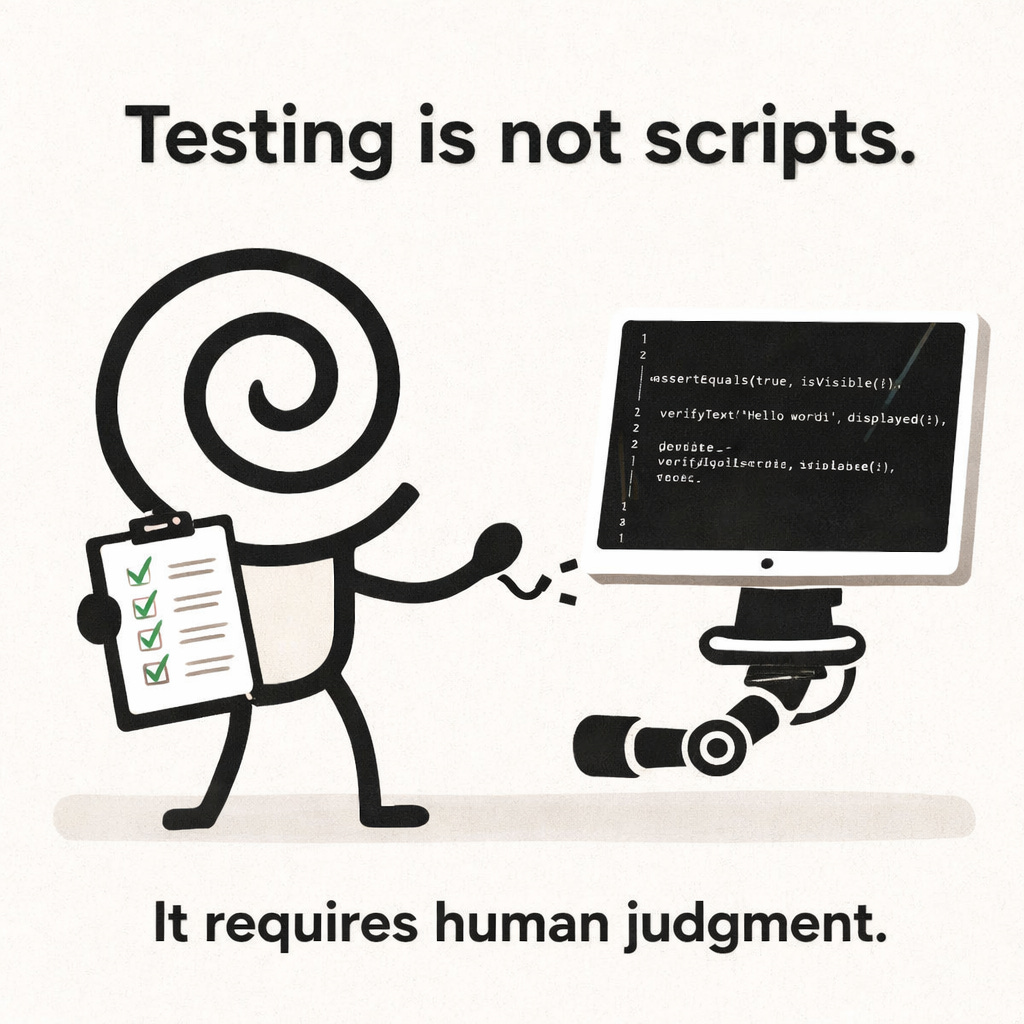
What People Are Really Declaring Dead
When people say “testing is dead,” they usually mean this:
Testing = executing predefined steps
Value = how many checks ran
Quality = green dashboards
In that model, testing is labor.
And labor, once automated, becomes disposable.
If that’s your definition, then yes.
Testing deserves to die.
The Cost of This Definition Is Invisible Until It’s Too Late
This model produces predictable outcomes:
High automation coverage with low confidence
Faster releases with weaker understanding
Fewer bugs found, but more surprises in production
Decisions made on output instead of insight
Nothing is technically “broken.”
And that’s the danger.
The system works.
The product quietly harms users.
No alert fires for misunderstanding.
That gap exists only when thinking has been optimized out.
Testing Was Never a Tool Problem
The industry keeps arguing about tools because tools are easy to compare:
Manual vs automation
Framework A vs framework B
AI tool X vs AI tool Y
But testing was never a tooling problem.
Testing is the act of learning about a product under uncertainty and exposing information that helps people make better decisions.
That learning does not come from execution alone.
It comes from:
Questioning assumptions
Noticing unexpected patterns
Interpreting behavior instead of trusting outputs
Deciding which risks matter now, and which can wait
No tool does that on your behalf.
A Small Moment That Explains Everything
Some of the most serious issues I’ve found didn’t come from running a test.
They came from asking a question no test case contained:
Why does this feature exist in the first place?
The code worked.
The automation passed.
The logic made sense in isolation.
The impact, once questioned, did not.
That moment is testing.
And it cannot be scripted.
Automation Changes the Job. It Doesn’t Remove It.
Automation removes repetition.
AI accelerates exploration.
Both are useful.
But acceleration without judgment creates confidence debt.
Someone still has to:
Decide what to trust
Interpret ambiguous signals
Explain risk in human terms
Push back when certainty is artificial
When teams remove people who can do that, they don’t become efficient.
They become blind faster.
Testing Is Not a Phase. It’s a Responsibility.
Testing is not something you “finish.”
It’s not a gate.
It’s not approval.
It’s an ongoing responsibility to understand:
What the system actually does
Who might be affected
Where uncertainty still exists
What is consciously not being tested
That responsibility cannot be automated away.
It can only be ignored.
So Is Testing Dead?
Only if you believed it was:
A checklist
A role defined by execution
A function justified by volume
A process step instead of a thinking discipline
That version deserves to disappear.
What replaces it is not fewer testers.
It’s fewer illusions.
A Better Question for the Future
Instead of asking:
Will AI replace testers?
Ask this:
When things go wrong in ways we didn’t predict, who is responsible for understanding why?
If the answer is “the tools,” something critical is already missing.
Testing isn’t dead.
It’s just no longer interested in pretending it was ever mechanical.
Still testing.
Still thinking.
If you found this helpful, stay connected with Life of QA for more real-world testing experiences, tips, and lessons from the journey!