


Every few months, the same headlines return:
“AI will replace humans.”
“Machines are becoming smarter than people.”
“Humans versus AI.”
The framing is dramatic.
It is emotional.
And it is commercially useful.
Fear attracts attention.
Attention sells products.
But the deeper problem is that the framing itself is wrong.
The real story is not machines competing against humanity.
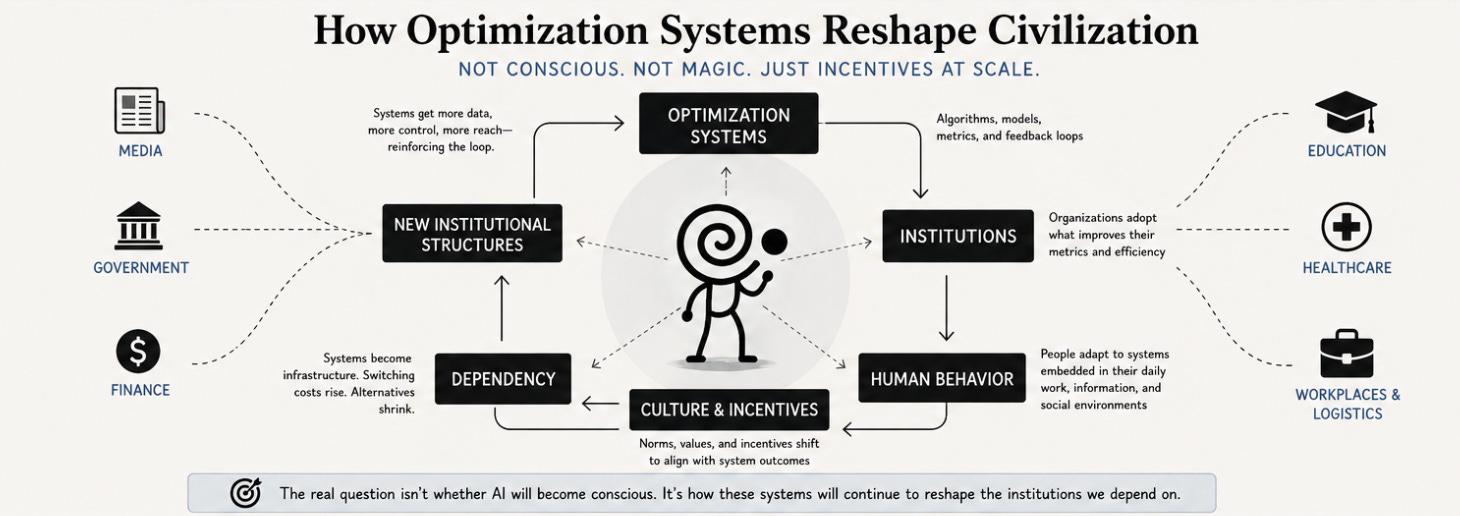
The real story is that increasingly powerful optimization systems are quietly becoming embedded into the institutions humans already depend on:
workplaces,
governments,
education,
finance,
healthcare,
logistics,
media,
and communication itself.
That transformation has already started.
And unlike the science-fiction version of AI, this one does not require consciousness, self-awareness, or machines “waking up.”
It only requires systems that are:
cheap,
scalable,
persuasive,
and operationally useful.
That is what makes this moment historically important.
The Technologies That Change Civilizations Usually Arrive Looking Useful
One of the biggest mistakes in AI discussions is assuming civilization will be transformed by some future superintelligence.
History suggests otherwise.
The technologies that reshape societies are usually not the most intelligent systems.
They are the systems that become:
infrastructure,
defaults,
habits,
and dependencies.
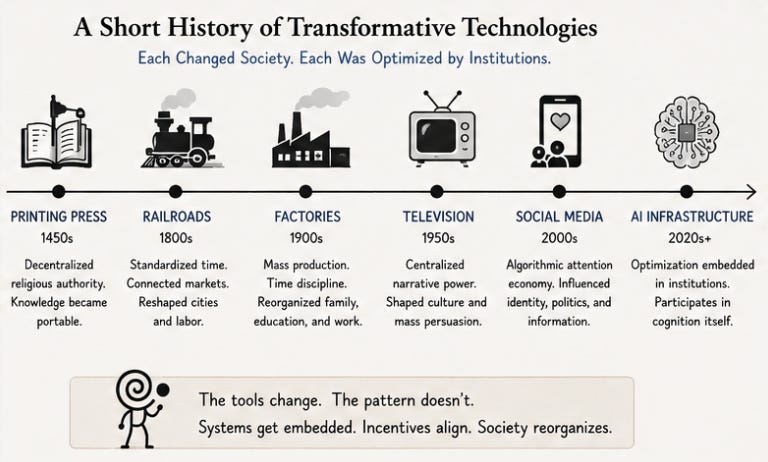
Railroads changed not only transportation, but time itself. Standardized time zones emerged because industrial coordination required synchronized clocks.
Factories did not merely increase production. They reshaped family structures, urbanization, labor discipline, education systems, and political organization.
Television did not just distribute entertainment. It centralized narrative power.
Social media did not merely connect people. It reorganized attention, journalism, politics, identity, and social validation around algorithmic incentives.
Civilizations are rarely transformed by invention alone.
They are transformed when institutions reorganize themselves around new forms of optimization.
That pattern matters far more than abstract debates about machine consciousness.
Because AI is entering institutions the same way:
quietly,
incrementally,
and through incentives.
AI Does Not Need Human Intelligence to Reshape Human Systems
Markets are not conscious.
Bureaucracies are not conscious.
Financial systems are not conscious.
Yet all of them profoundly shape civilization.
AI systems are becoming similar kinds of forces:
not human minds,
but optimization layers embedded into institutions.
A hiring system does not need empathy to filter candidates.
A recommendation engine does not need self-awareness to shape attention.
An AI support system does not need consciousness to replace workers.
It only needs to function well enough that organizations decide:
the efficiency gains are worth the tradeoffs.
That is the real transition happening now.
And organizations rarely optimize for perfection.
They optimize for:
acceptable performance,
scalability,
speed,
liability reduction,
and cost efficiency.
Amazon reportedly abandoned an internal AI hiring system after discovering it penalized resumes associated with women because the model had learned patterns from historically male-dominated hiring data.
That example matters because it reveals something deeper:
Optimization systems inherit institutional history automatically.
The system was not consciously sexist.
But neither was it neutral.
That is how many powerful systems reshape society:
not through intent,
but through scaled reinforcement of existing structures.
And history shows something uncomfortable:
Systems do not need to be excellent to replace humans.
They only need to become cheaper than human judgment.
That may become one of the defining economic pressures of the AI era.
The Economic Disruption Is Real. But So Are the Counterforces.
A lot of people respond to AI fears by saying:
“AI is just a tool.”
That is true.
But industrial machines were “just tools.”
So were spreadsheets.
So was the internet.
Tools can still reorganize labor systems.
Right now, companies are already experimenting with replacing portions of:
customer support,
administrative coordination,
translation,
tutoring,
copywriting,
junior programming,
and research assistance
with AI-assisted workflows.
Not because the systems are perfect.
Often they are not.
But because businesses frequently optimize for:
acceptable output,
lower labor cost,
scalability,
and operational speed.
Factories did not replace artisans because machines produced better craftsmanship.
Factories won because standardized scale outcompeted individualized excellence.
AI may pressure cognitive work the same way.
But history also complicates simplistic automation narratives.
Industrialization destroyed many forms of labor.
It also created entirely new industries.
The internet centralized enormous power.
It also dramatically lowered publishing and coordination barriers.
Open-source software challenged some of the largest corporations in history.
Technological systems often centralize and decentralize simultaneously depending on the layer being examined.
That tension matters.
The future is unlikely to become:
total machine replacement
or
frictionless technological prosperity.
More likely, AI will create:
productivity gains,
labor displacement,
new forms of expertise,
institutional concentration,
and new forms of resistance
all at once.
But one thing does seem increasingly plausible:
AI may compress the economic value of average cognitive labor the same way industrial machines compressed the value of average physical labor.
If that happens, the consequences will not just be technological.
They will be political,
economic,
psychological,
and cultural.
The Real Power Struggle Is About Infrastructure
The most important AI question may not be:
“How intelligent will AI become?”
The more important question may be:
“Who owns the infrastructure?”
Because AI is not floating in abstraction.
It runs on:
semiconductor supply chains,
massive data centers,
energy infrastructure,
cloud platforms,
proprietary models,
and enormous capital investment.
That matters because ownership shapes power.
Right now, frontier AI development is concentrated among:
giant corporations,
state-backed labs,
and military-adjacent ecosystems.
And their incentives are not mysterious.
Mostly, they are optimizing for:
market dominance,
strategic leverage,
productivity,
shareholder value,
and geopolitical advantage.
Not necessarily:
democratic resilience,
public understanding,
or long-term social stability.
People often assume decentralization will eventually balance concentration naturally.
Maybe.
History gives mixed evidence.
The printing press decentralized religious authority.
Television recentralized narrative power.
The internet decentralized publishing while simultaneously concentrating digital infrastructure into a handful of platforms.
Technology does not move in one direction politically.
It reorganizes power unevenly.
That is why the most important AI question may not be whether intelligence becomes superhuman.
It may be whether civilization becomes dependent on cognitive infrastructure controlled by too few actors to meaningfully challenge.
Human Beings Are Not Programmable. Institutions Are Much Easier to Shape.
One of the most exaggerated fears about AI is the idea that humans will become perfectly programmable.
Human societies are too chaotic for that.
People resist systems constantly.
They:
abandon platforms,
distrust institutions,
create countercultures,
and behave irrationally.
Social media did not produce perfectly engineered populations.
It produced outrage, fragmentation, distrust, loneliness, performative identity, and information overload.
Human behavior is messy.
But institutions are different.
Institutions are highly sensitive to optimization pressure.
Corporations optimize:
efficiency,
growth,
retention,
and productivity.
Platforms optimize:
engagement,
attention,
and behavioral data.
Governments optimize:
administrative capability,
surveillance capacity,
and strategic advantage.
Institutions adopt systems that improve measurable metrics even when long-term consequences become socially harmful.
That is already observable reality.
The danger is probably not:
“AI controls humanity.”
The more realistic danger is:
institutions normalize harmful optimization because competitive systems reward it.
That is less cinematic than machine rebellion.
But probably far more important.
Dependency Changes Human Behavior Quietly
The biggest technological shifts usually feel helpful before they feel transformative.
Autocomplete changed how many people construct sentences.
Navigation apps changed how people relate to physical space.
Recommendation systems changed how people discover music, news, relationships, and even identity itself.
These shifts often seem small individually.
But over time, tools reshape habits.
Habits reshape expectations.
And expectations reshape culture.
Marshall McLuhan once argued that societies are shaped less by the content of media than by the structure of the medium itself.
That insight matters even more now.
AI may not simply change what humans produce.
It may gradually change:
how humans think,
how humans communicate,
what humans value,
and which forms of cognition become economically rewarded.
Some people will become dramatically more capable using AI systems effectively.
Others may become increasingly dependent on systems they barely understand.
That asymmetry matters.
Because the future may not divide society between:
humans,
and machines.
It may divide people between:
those who can direct intelligent systems,
those who can verify them,
and those who passively depend on them.
That distinction could become economically decisive.
The Future Will Probably Be Uneven, Messy, and Politically Contested
The most unrealistic AI narratives usually come from extremes.
One side believes AI will solve nearly everything.
The other believes AI inevitably leads to collapse.
History rarely works that cleanly.
More likely, the future will involve:
uneven automation,
labor disruption,
productivity gains,
fragmented regulation,
geopolitical competition,
infrastructure concentration,
open-source resistance,
institutional confusion,
public backlash,
and continuous adaptation.
Some fears will be exaggerated.
Some warnings will arrive too late.
Some industries will transform quickly.
Others will barely change for decades.
That is usually how technological transitions actually happen.
Messily.
Final Thought
The AI debate should not revolve around:
“Will machines replace humans?”
That question is too shallow.
The deeper question is this:
What happens when optimization systems become embedded deeply enough into civilization that institutions can no longer realistically function without them?
Because AI is not humanity’s rival.
And it is not humanity’s savior either.
It is infrastructure.
And throughout history, infrastructure has quietly reshaped civilizations long before people fully understood what was changing.
The difference this time is that the infrastructure may also be reshaping how humans think, decide, communicate, work, and understand reality itself while the transition is still happening.
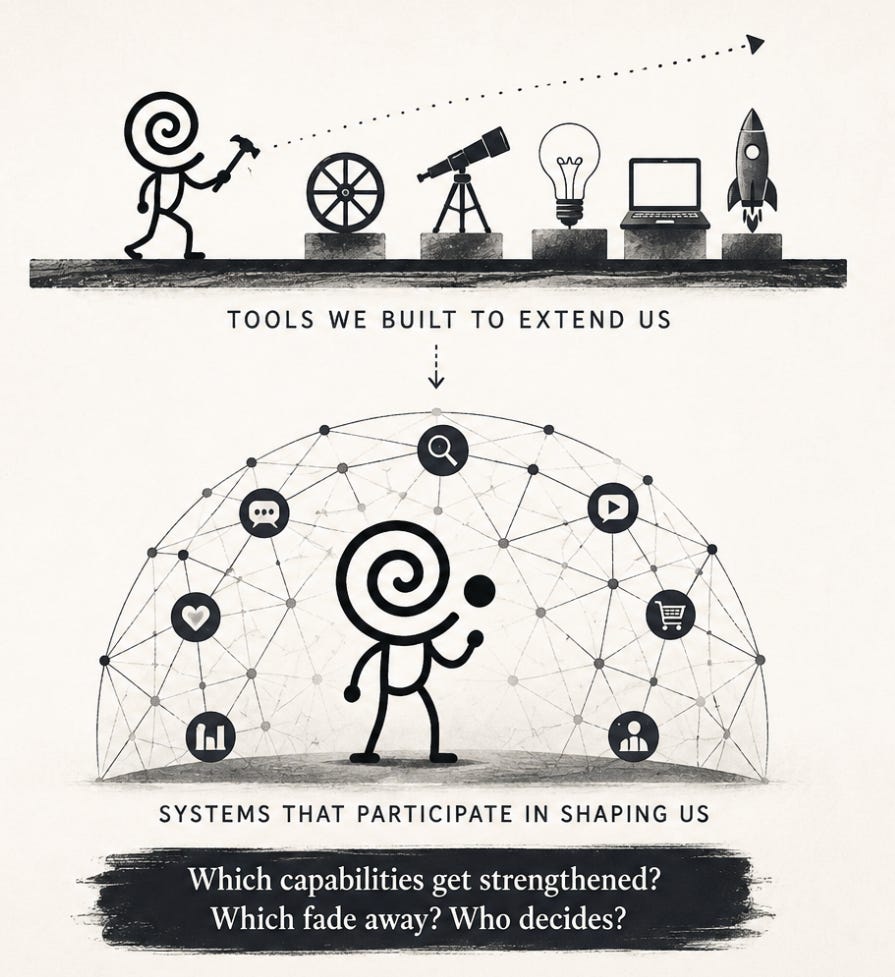
Civilizations once built tools to extend human capability.
This may become the first time humans build systems that increasingly participate in deciding which capabilities still matter.
Further Reading
If you found this useful, you might also enjoy these articles:


If you found this helpful, stay connected with Life of QA for more real-world testing experiences, tips, and lessons from the journey!
I can see you have put some real-life examples, which is why this is standing out. And yes! AI is making changes in our lives and our daily routine.
Nice piece! Just finished and published my article - would love for you to have a look or a listen 😉
https://substack.com/@skepticalsociopath/note/p-200143056?r=wxwe9