


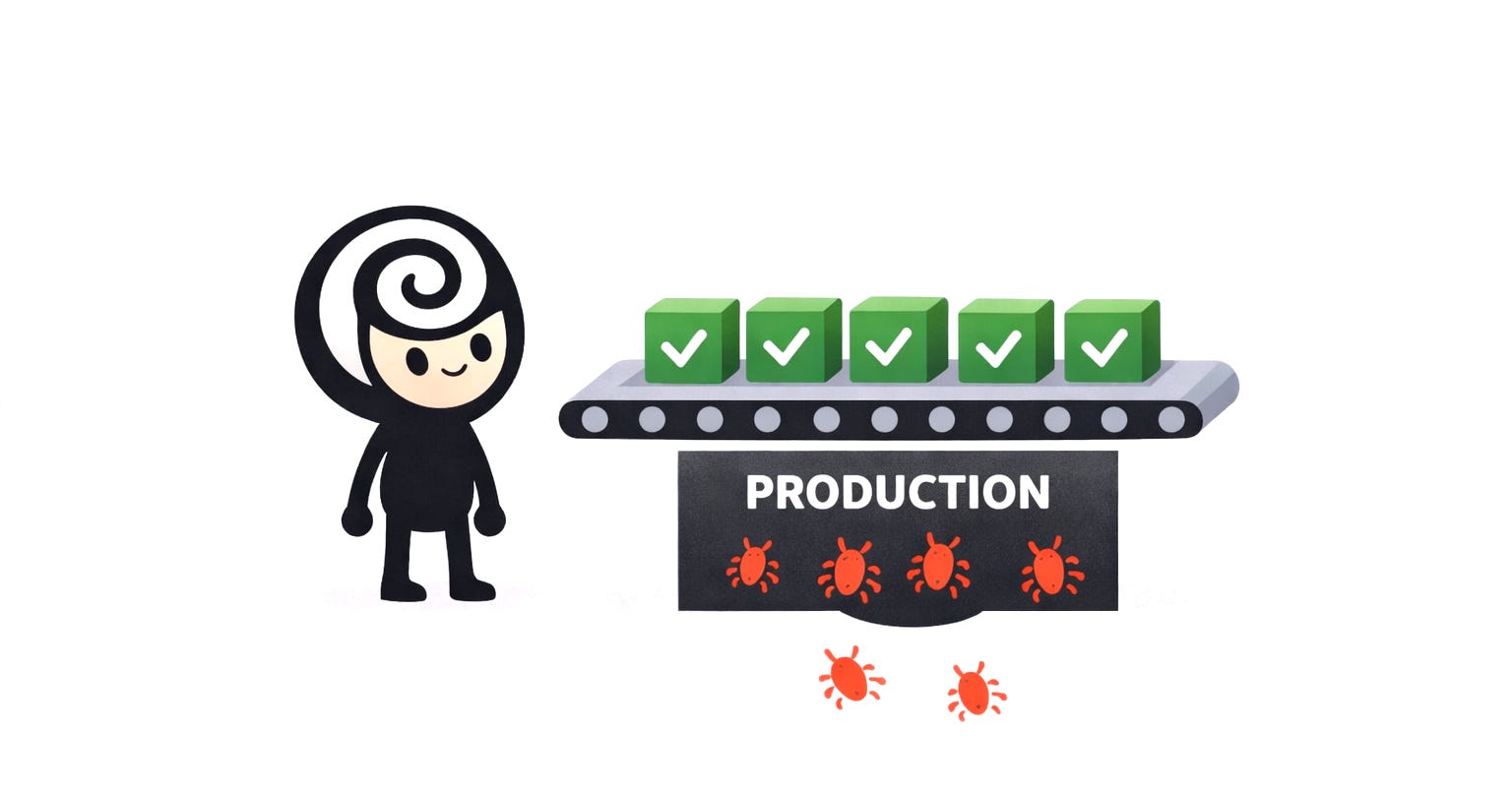
Most automation suites don’t protect products.
They protect comfort.
Green pipelines. Clean dashboards. Confident releases.
And bugs still reach production.
When that keeps happening, automation usually isn’t weak.
It’s doing exactly what the system around it rewards.
It’s producing confidence, not exposing risk.
I know this because I built automation like this and defended it.
How comfort slowly replaces truth
Early on, our goal was simple: move faster without breaking things.
So we automated the clean flows first.
Happy paths.
Expected inputs.
The stories everyone already understood.
The pipeline turned green quickly.
Leadership was impressed.
Releases felt smoother.
I was praised for “stabilizing quality.”
What we didn’t automate were the awkward parts:
• broken states
• retries
• bad data
• half-finished workflows
• system recovery after failure
Not because we didn’t know they mattered.
Because they were slower.
Harder to explain.
And uncomfortable to block releases over.
Green was rewarded.
Risk was invisible.
So I kept choosing green.
The moment it broke through the illusion
Three months later, we had a production incident that duplicated customer transactions for hours.
Money moved twice.
Support exploded.
Engineering went into emergency mode.
Someone said:
“But all our tests passed.”
They were right.
We had hundreds of passing scripts around that flow.
What none of them covered was what happened when a timeout triggered retries halfway through processing.
We never tested the messy middle.
Because it didn’t fit nicely into acceptance stories.
Because it slowed us down.
Because it didn’t keep the dashboard green.
That was the moment I realized:
Our automation wasn’t guarding the system.
It was guarding our sense of control.
Where real failures actually begin
Major outages rarely start with happy paths breaking.
They start when systems are under pressure.
Things like:
• retries duplicating actions
• partial writes corrupting data
• services recovering badly
• permissions leaking across boundaries
• workflows freezing mid-process
These are boring to automate.
They don’t demo well.
They don’t make numbers go up fast.
They also cause most serious damage.
Why teams keep choosing comfort (even when they know better)
It isn’t ignorance.
It’s incentives.
Teams are praised for:
• faster releases
• green pipelines
• growing test counts
• “not blocking progress”
No one gets rewarded for:
• slowing a release to discuss risk
• building ugly failure tests
• questioning fragile design
• exposing uncertainty
So people do what smart humans always do.
They follow what the system praises.
And the system praises green.
How signal slowly dies
First, flaky failures appear.
“Just rerun it.”
Soon reruns become routine.
Failures become noise.
Noise gets ignored.
Eventually the pipeline becomes decoration.
Always green.
Rarely trusted.
Still used as proof everything is fine.
The activity trap
More scripts every sprint.
The same production incidents.
That usually means:
Easy scenarios got automated.
Dangerous ones stayed untouched.
Progress got measured in volume.
Risk stayed invisible.
When automation becomes a mirror of expectations
Many suites are just requirements replayed in code.
Click this.
Enter that.
Expect success.
They confirm what teams already believe should happen.
They don’t challenge what the system actually does under strain.
Serious defects live outside neat stories.
The simplest reality check
Ask:
How often does automation catch serious issues first?
Not broken locators.
Real failures like:
• wrong money movement
• corrupted data
• access leaks
• broken recovery behavior
If the answer is “almost never,” your automation isn’t protecting the product.
It’s rehearsing what already behaves.
What automation looks like when safety is the goal
Automation aimed at safety is usually smaller and sharper.
It often targets:
• boundaries where systems break
• failure and recovery paths
• messy states humans avoid
• integrations under stress
• behaviors that hurt when wrong
It leaves room for human investigation.
Not because automation is weak.
Because learning still matters.
This approach feels slower.
It creates harder conversations.
It exposes uncertainty.
It also prevents the kind of incidents dashboards never warn you about.
The question that cuts through illusion
Ask your team:
“If every automated test passed right now, what could still seriously damage us?”
If the answer is “a lot,”
your automation is building confidence, not safety.
Final thought
Automation doesn’t drift into comfort mode.
Teams guide it there.
Because green feels safer than doubt.
Because speed gets rewarded.
Because risk is inconvenient.
I helped build systems like this.
They looked strong.
They ran fast.
They failed quietly until users paid for it.
Confidence is easy to automate.
Safety takes courage.
Further Reading
If you found this useful, you might also enjoy these articles:


If you found this helpful, stay connected with Life of QA for more real-world testing experiences, tips, and lessons from the journey!